 The Station Wagon
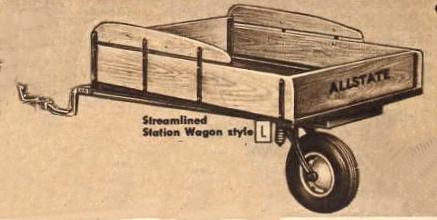
In the years following World War II, as consumer demand for recreational and utility equipment grew once more, Sears continued to refine and expand its popular line of single-wheel trailers. In the Fall 1949 Sears Catalog, the company introduced a new variation to its lineup—an updated model that shared the same trapezoidal steel frame and load-carrying capacity as the earlier version, but differed primarily in the design of its cargo box. This new model was marketed as the “Station Wagon” version, an evocative name that suggested both style and practicality for postwar American families on the move.
The Station Wagon trailer featured a more sophisticated and visually appealing construction. Its two-piece side panels were crafted to create a distinctive “streamlined” look, with the upper panels shaped in a teardrop contour and separated from the lower panels by a narrow horizontal gap. Unlike the standard model, which was finished in solid blue paint, the Station Wagon’s body was varnished instead of painted, leaving the natural wood grain elegantly visible—a detail that gave it a warm, handcrafted appearance and aligned with the popular design aesthetics of the late 1940s.
According to the 1949 Sears Fall Catalog, the Station Wagon model was priced at $67.95, a modest reduction from its previous spring catalog price of $69.95. By the time the 1950 Sears Fall Catalog was released, the price had been further reduced to $64.95, and the trailer now proudly displayed the “ALLSTATE” logo across its rear tailgate, reflecting Sears’ ongoing effort to unify its automotive and trailer products under the recognizable brand name.
The 1952 Sears Fall Catalog marked the final appearance of the Station Wagon trailer in Sears’ product listings, with its price reverting to $67.95. After this year, the model was quietly discontinued, bringing an end to a brief but memorable chapter in Sears’ postwar trailer offerings—a period that showcased the company’s innovation, design experimentation, and ability to adapt to the evolving tastes of mid-century American consumers.